Book Appointment Now
Hiring Christmas Casuals in 2026? Your Payroll and Payday Super Checklist
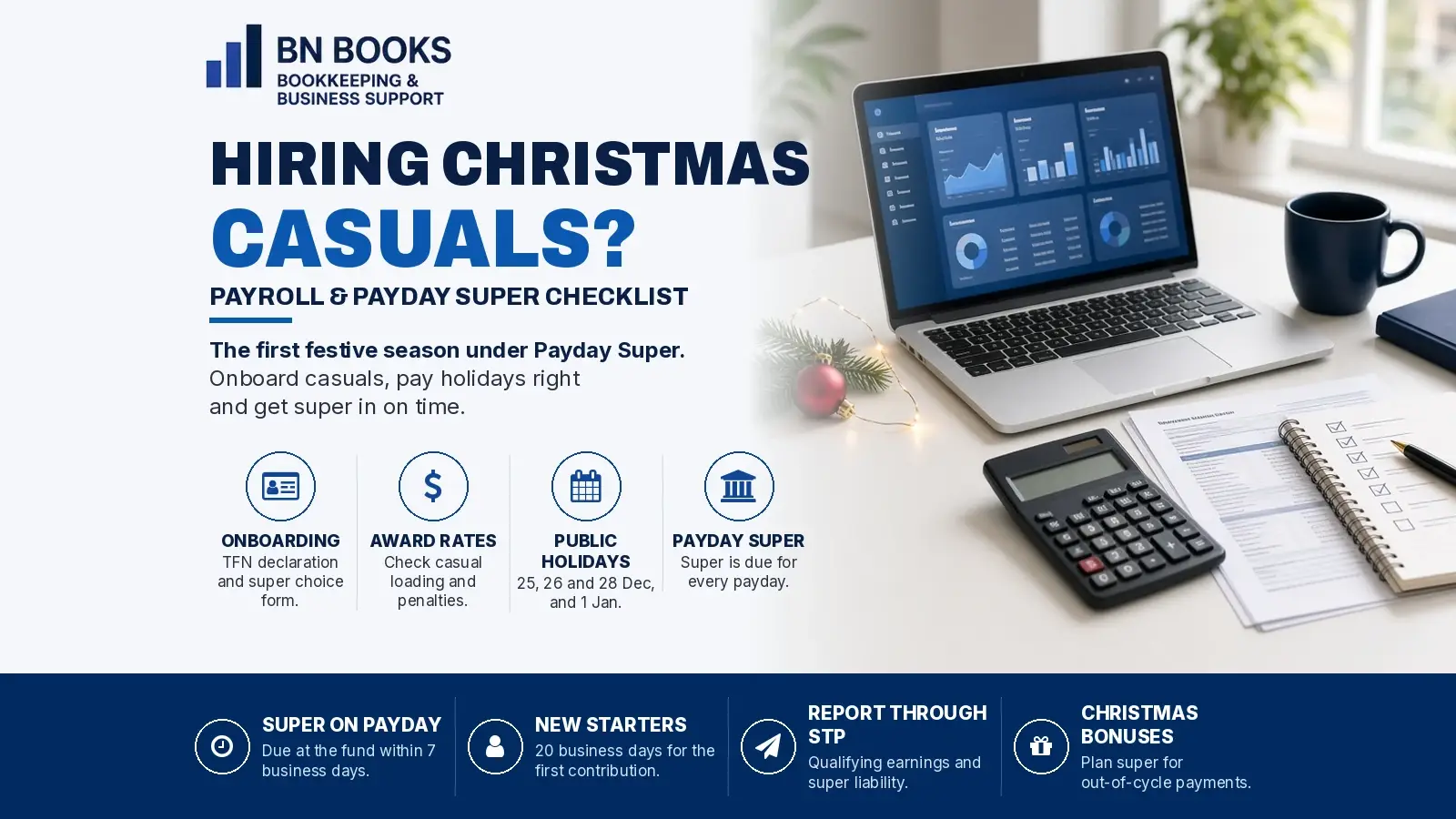
Putting on extra staff for the Christmas rush? This is the first festive season under Payday Super. Here's your checklist for onboarding casuals, paying them correctly over the public holidays and getting their super in on time.
For lots of small businesses, the lead-up to Christmas means extra shifts, extra customers and a few extra pairs of hands.
This year there’s one big difference: Payday Super. From 1 July 2026, super is no longer a quarterly job. If you’re hiring Christmas casuals this year, here’s the payroll checklist to work through before their first shift.
Before they start: the paperwork
Check they can work in Australia
The ATO reminds employers to confirm a new worker is legally allowed to work in Australia. If you’re hiring a backpacker on a working holiday visa (subclass 417 or 462), you also need to register as an employer of working holiday makers before you pay them.
Employee or contractor?
A seasonal worker isn’t automatically a contractor just because the job is short-term. The ATO says you need to look at the whole working relationship, and it’s against the law to wrongly treat an employee as a contractor. Even genuine contractors can be entitled to super if they’re paid mainly for their labour.
Tax and super forms
When you induct a new employee, the ATO says you’ll need:
- a Tax file number declaration (or the employee’s online commencement forms through ATO online services, which must be completed within 28 days of starting)
- a Superannuation standard choice form, so they can nominate their own fund.
If a new employee doesn’t provide their TFN (and doesn’t claim a valid exemption), you must withhold tax at the top rate, plus Medicare. If you have questions about withholding or your wider business tax obligations, our sister practice BN Tax can help. If they don’t choose a super fund, you may need to request their stapled super fund details from the ATO. Since 27 March 2026, you can request stapled fund details and offer them to the employee at the same time as the choice form.
Fair Work information statements
The Fair Work Ombudsman requires you to give every new casual employee the Fair Work Information Statement and the Casual Employment Information Statement before, or as soon as possible after, they start.
Getting their pay right
Casual loading and award rates
Under the Fair Work Act, a casual employee has no firm advance commitment to ongoing work and is paid a casual loading or a specific casual pay rate. Many awards set the casual loading at 25%, but rates, penalty rates and minimum shift lengths depend on the award or agreement that covers the job. Fair Work’s Pay and Conditions Tool is the place to check.
Christmas public holidays
The Christmas and New Year public holidays in 2026–27 are:
- Friday 25 December: Christmas Day
- Saturday 26 December: Boxing Day (Proclamation Day in South Australia)
- Monday 28 December: additional public holiday in most states and territories (in Tasmania, Monday 28 December is the Boxing Day holiday)
- Friday 1 January 2027: New Year’s Day.
Queensland, South Australia and the Northern Territory also have part-day public holidays on the evening of Christmas Eve, and South Australia and the Northern Territory on New Year’s Eve evening.
Casuals aren’t paid for public holidays they don’t work. If they do work, Fair Work says they must be paid at least their base rate, and many awards add public holiday penalty rates. Remember too that employees can refuse a request to work on a public holiday if the request is unreasonable or they have reasonable grounds.
Payday Super: what changes for your casuals
Here’s where Christmas payroll looks different this year.
Super is due for every payday
From 1 July 2026, the ATO requires super guarantee to be paid for each payday. The contribution must be received by the employee’s super fund within 7 business days after you pay them, with enough information for the fund to allocate it. The rate is still 12%, now calculated on qualifying earnings.
The ATO’s advice is simple: pay super on payday. If you use a clearing house or payroll software to send contributions, allow time for processing. The ATO’s Small Business Superannuation Clearing House has closed, so if you were still relying on it, you’ll need another option.
A little longer for new starters
For the first contribution for a new employee, the ATO allows longer: the money must reach the fund within 20 business days after that first payday. From the second payday, the normal 7 business day timeframe applies.
Who gets super?
Casuals are eligible for super. There’s no minimum earnings threshold, so you pay super no matter how little someone earns. The exception is employees under 18: they’re only eligible for super guarantee in a week where they work more than 30 hours. That’s based on actual hours worked that week, not an average across a fortnight or month, which matters for school leavers picking up big weeks before Christmas.
Christmas bonuses
Paying a bonus outside your normal pay run? The ATO treats this as an “out-of-cycle” payment. The super is due 7 business days after the employee’s next regular payday. In the ATO’s own example, a Christmas bonus paid on 7 December 2026 with a regular payday on 10 December means super for both is due by 21 December 2026.
Public holidays change the count
For Payday Super, a business day excludes weekends and any day that’s a public holiday across a whole state or territory, even if it isn’t a holiday where you are. With 25 December, 28 December and 1 January all falling on weekdays, your 7 business day window stretches over the break.
Report it through Single Touch Payroll
Under Payday Super, you report both qualifying earnings and super liability through Single Touch Payroll (STP). Set each casual up correctly in your payroll software from day one and STP will do much of the heavy lifting.
Your quick Christmas casuals checklist
- Confirm work rights (and register for working holiday makers if needed).
- Check whether they’re an employee or a contractor.
- Collect the TFN declaration and super choice form, or request stapled fund details.
- Give them the Fair Work Information Statement and Casual Employment Information Statement.
- Check the award: casual rates, penalty rates and public holiday rates.
- Set them up correctly in your payroll software for STP.
- Pay super on payday, and diarise the 20 business day deadline for first contributions.
- Plan super for any Christmas bonuses.
If your payroll records are already a little shaky, read our article on the signs your bookkeeping needs attention.
Let BN Books take payroll off your plate
BN Books has been looking after bookkeeping and payroll for Australian small businesses for more than 20 years. We’re 100% remote and work with businesses Australia-wide. We can set up your seasonal staff, run your pays, manage Payday Super and STP reporting, and keep your records ready for BAS time.
See our payroll and bookkeeping services, call us on 1300 790 113, or get in touch online. We know small business!
This article is general information only. Pay rates and conditions depend on the award or agreement that applies to your business. Check with the Fair Work Ombudsman or a professional for advice on your situation.
Sources: ATO: Payment deadlines for Payday Super · Fair Work Ombudsman: Casual Employment Information Statement